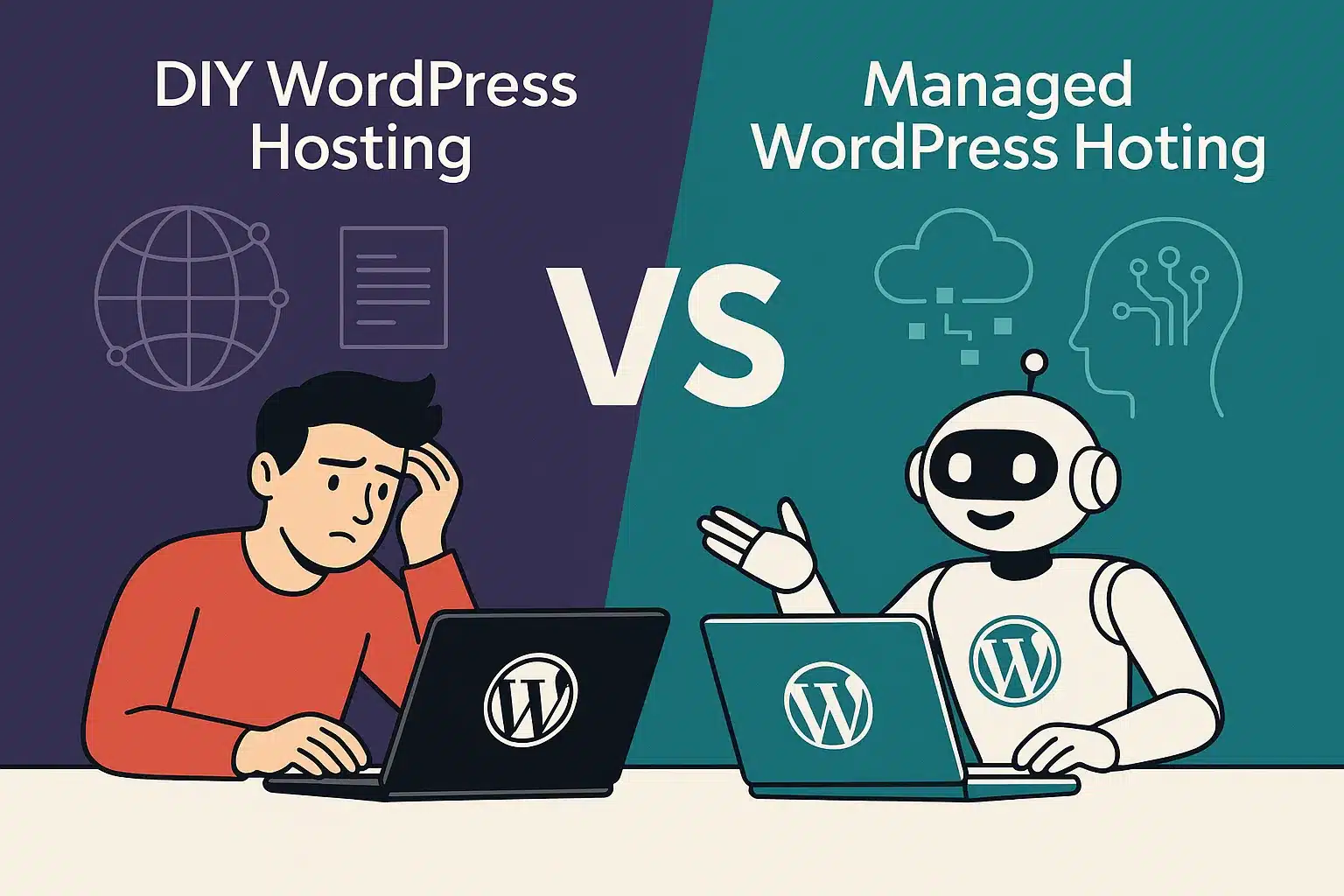
What is WordPress hosting?
Standard web hosting services provide websites with the server space and resources required to deliver content online. There are four main types of hosting: shared, dedicated, VPS, and cloud.
However, since WordPress is the most popular CMS in the world, there’s an entire category (and industry) of WordPress hosting services designed explicitly for this CMS.
WordPress hosting plans should work seamlessly with all of the WordPress core software and other essential tools like plugins and themes. For example, a WordPress host may offer seamless installation of the CMS via a one-click installation process. It might also guide you through a WordPress-specific setup wizard and install specific plugins and tools.
Additionally, with this type of hosting, the servers are usually optimized for peak WordPress performance. The support team should also be particularly knowledgeable about this CMS.
World-class infrastructure finely tuned for WordPress empowers your site with the (TTFB) in the industry.
EverCache®, our proprietary WordPress caching, sustains lightning-fast speeds as you scale beyond thousands of hits per minute.
Global CDN with over 200 data centers allows for peak performance regardless of where your traffic lives.
What is managed WordPress?
With a managed hosting plan, you won’t have to worry about tasks like server configuration, maintenance, performance monitoring, and so on. Some of the best managed hosts will even provide extra optimization and security services. You’ll pay a slightly higher price in return for help managing your site.
Unlike the four “core” types of web hosting services, managed hosting isn’t completely determined by server type. Shared, VPS, dedicated, and cloud hosting plans can all be either “managed” or “unmanaged.”
Automated updates for plugins, themes, WordPress, and PHP with auto roll-back functionality gives you hours back every week.
DDoS Protection and managed WAF customized for WordPress proactively protects your site from potential threats.
Annual SOC 2 audits and ISO 27001 certification ensures your sites adhere to two of the most rigorous international security and compliance standards.
24/7 phone and chat access to experts in WordPress that help you troubleshoot in minutes with a 96% customer satisfaction score.
Extensive WordPress-specific support documentation with detailed step-by-step guides to resolve the simplest to most complex issues.
White-glove onboarding with a 40+ point Technical Health Check makes your migration seamless and your launch successful. Available for premium plans only.
An introduction to the WordPress CMS
Creating and running a website requires a lot of different tasks. For example, you have to write and publish content, manage the design of your site, administer to your users, and so on.
A Content Management System (CMS) is the perfect solution. As the name suggests, the primary job of a CMS is to make content management easier. A CMS can help you with this work, since it provides a fully-featured platform for creating content, publishing it online, and managing it. All of this can be done through an interface that doesn’t require you to have much technical know-how.
At the same time, you’ll find that many CMSs provide a developer-friendly structure under the hood. This means that if you do have coding experience, you can easily mold them to meet your exact needs.
Website hosting or web hosting is a service that enables you to put your content on the internet. It provides space on a server that stores your website’s files and makes them available online.
Servers are the structures powering the world wide web—made up of both hardware and software. Their job is to process online user requests and deliver content via browsers.
Through a series of web protocols, servers can access a website by following a web address that’s typed into your browser. The type of server and optimization tools you choose will significantly affect your site’s performance.
Servers require lots of resources, maintenance, and management, so web hosting is provided by private companies. These are typically referred to as “web hosts” or “hosting providers” (or just “hosts”). Each web host will usually offer multiple hosting plans that vary based on server configurations and added features.